Embedded systems / Industrial project / 2023–2024
Multi-channel battery charging and testing system
Firmware, measurement and system integration for a team-built device with six charging channels and six measurement channels.
- Period
- 2023–2024 · Delivered Aug 2024
- Controller
- STM32F103
- My focus
- Firmware & system integration
The project
Developed at Anhui University to meet the requirements of Ningxia Electric Power Energy Technology Co., Ltd., this device brings battery charging and consistency testing into one multi-channel system. A common state-of-charge (SOC) calibration process precedes the acquisition of open-circuit-voltage and internal-resistance-related measurements.
The team delivered equipment with six charging channels and six measurement channels in August 2024. My work centred on the STM32 firmware and the integration of acquisition, communication and user interaction.
My contribution
- Firmware and scheduling. Developed initialisation, channel enabling and configuration, charging-process management, state machines and multi-channel task scheduling on STM32F103.
- Measurement. Implemented ADC acquisition and digital processing, connecting the measurement modules to the main controller. The system used a 24-bit sigma-delta ADC.
- Communication and HMI. Implemented LoRa and RS485 data and command exchange, SOC-calibration process logic and LCD/HMI interaction.
- Integration and delivery. Contributed to system architecture, module decomposition, development planning, hardware/firmware debugging and the final assembly design in SolidWorks.
Supervisory control and power regulation
The STM32F103 supervises channel states, process sequencing, scheduling, acquisition and communications. An independent TL494 + BUCK power stage provides the constant-current / constant-voltage (CC/CV) regulation loop.
LoRa provides wireless communication, while the system also includes an RS485/MODBUS wired path. The controller coordinates the device’s processes and exchanges measurement data and commands with the other modules.
Working within the team
The device uses an externally sourced analogue measurement module for internal-resistance signal processing. I integrated its output with the main controller through ADC acquisition and digital processing.
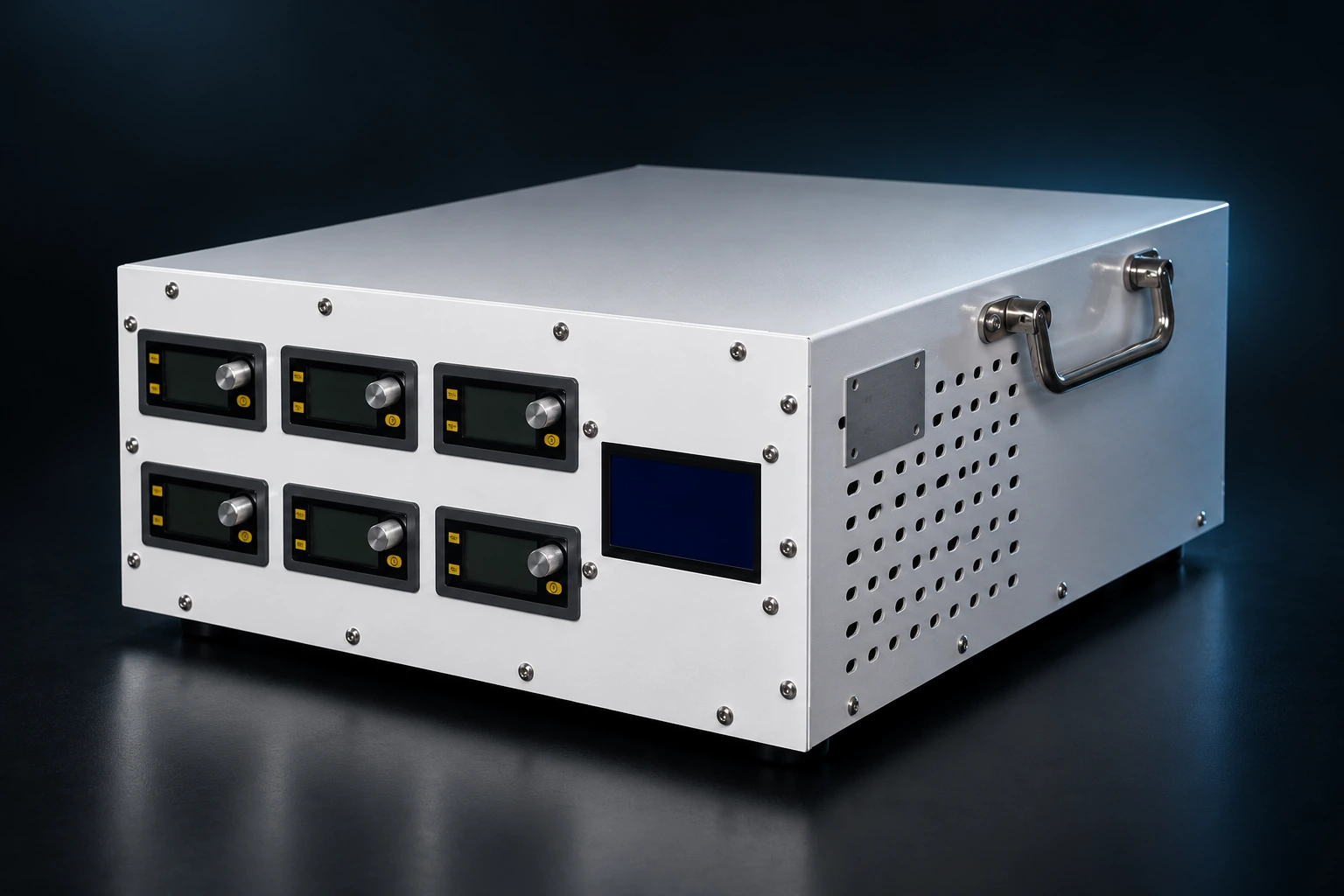
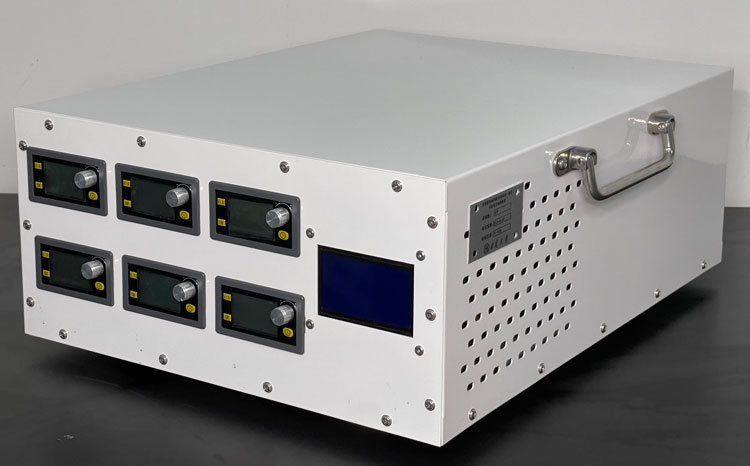
The original device photograph and enclosure CAD are team project records. The studio render is an AI-assisted presentation based on the original photograph. Alongside the firmware, I contributed to integration, assembly design and delivery-stage improvements.
Delivery and recognition
The system was delivered in August 2024. The same device was entered in the 3rd University Electrical and Electronic Engineering Innovation Competition and received First Prize at Anhui provincial level.
Explore the control flow
Select a stage to explore the system and my role.
Battery supervision
Six charging channels · six measurement channels
Channel scheduling
I implemented channel enabling and configuration, state machines and multi-channel task scheduling in the STM32F103 firmware.
Charge & SOC process
I implemented charging-process and SOC-calibration sequencing. The TL494 + BUCK stage provides the independent CC/CV power-regulation loop.
Acquire measurements
I implemented ADC acquisition and digital processing. Internal-resistance analogue signal processing uses an externally sourced module.
Data & interaction
I implemented LoRa and RS485 data and command exchange, along with LCD/HMI interaction.
My focus: STM32 firmware, acquisition, communication and system integration.